
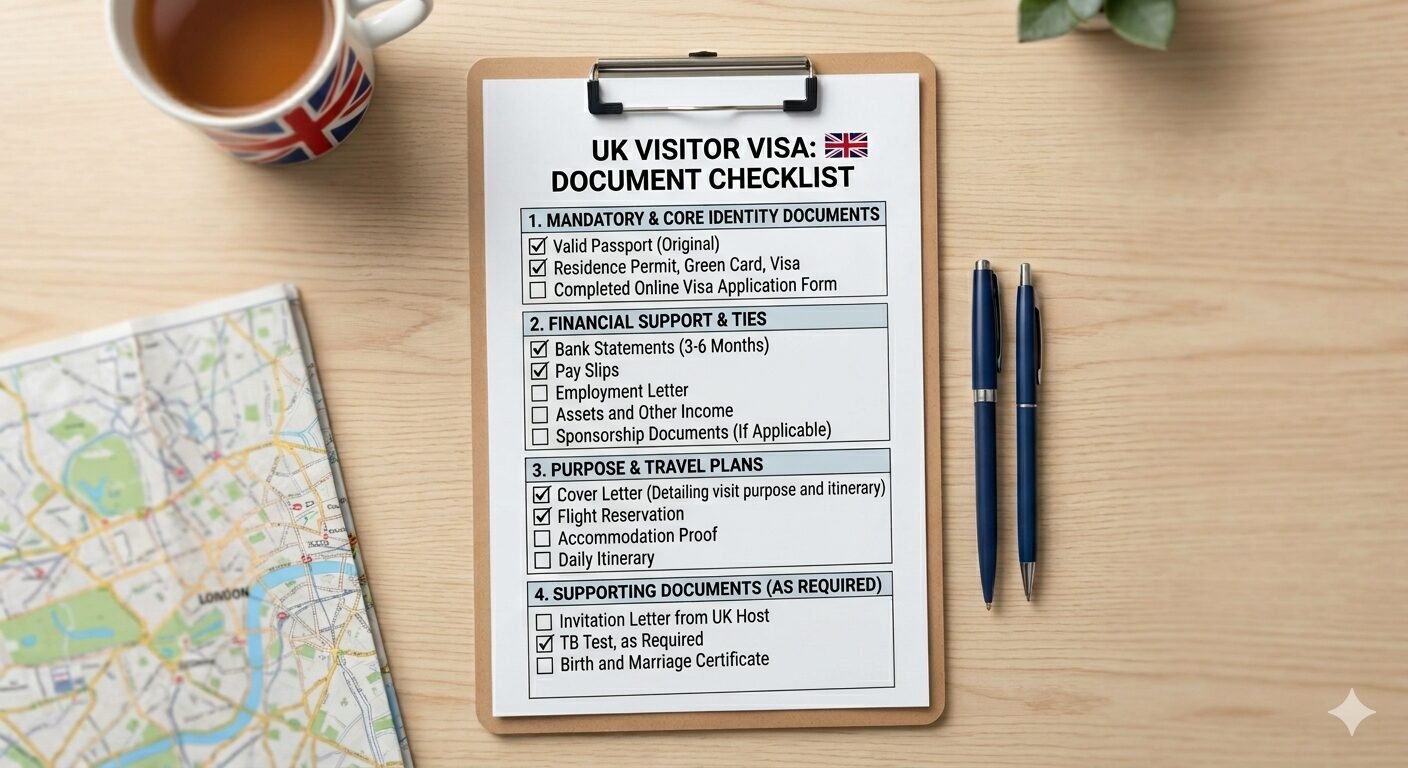
UK Visitor Visa Documents Checklist: What I Submitted and Why It worked
The UK visa application process can be quite tricky because there is no single official checklist provided by UK Visas and Immigration (UKVI). Applicants instead must submit sufficient evidence to satisfy the UKVI caseworker, on balance of probabilities, that they meet the eligibility requirements for the visa.
When you complete the application, it generates get some sort of Document checklist, based on information provided in your application.
However, this checklist is not always exhaustive! Applicants have missed a document by just sticking to the documents on that list (crazy, right?)
That checklist should influence you, but it’s not a foolproof guide.
When I’ve applied for my UK tourist visa multiple times now, I’ve always wondered whether I submitted enough documents, or even if those are the right required documents.
Well, this post shares exact documents I submit and why each one matters, as well as which requirement is being assessed with each required document.
Documents Required for a UK Visitor Visa Application
Mandatory and Core Identity Documents
- Passport
- Residence Permit, Green Card, Visa
- Completed online visa application form
- Payment confirmation of visa fee
- Biometric enrolment, i.e. fingerprints and photographs
Home Address
Document showing where you live, like:
- property deed
- mortgage statement
- tenancy agreement or rental contract
- land registration documents
Proof of Income and Savings(Financial Evidence)
- Documents like bank statements, bank books, bank letter, balance certificate, tax returns
- Document showing another person can pay for your visit, including
- Sponsor’s financial proof
- Sponsorship letter
- Proof of relationship
- Evidence of sponsor’s UK immigration status (if applicable)
Employment and Source of Income
- Letter from employer confirming role, salary and employment status
- Payslips for 3-6 months
If self-employed
- Tax returns
- Business statements
- Evidence of savings
If in studies:
- Evidence of being a student
- Proof of qualifications
Proof of ties to home country
Assets
- Deed
- mortgage statement
- accountant’s letter
- Long term financial commitments like land registration
- Business ownership documents
Family & personal ties – evidence showing family in home country
Travel Plans and Purpose of Visit
Varies depending on your reason for travel. As an example,
For tourism,
- Accommodation bookings, and flight bookings – or mention of these plans
- Itinerary mentioned in cover letter
Cover Letter
TB test results, if relevant
The Main Mistake Applicants Make with UK Visa Supporting Documents
The biggest mistake I see (and one I have previously made myself) is assuming that submitting more documents makes your application stronger.
Submitting more documents can do the opposite – it can confuse caseworker by adding inconsistencies!
More documents don’t always mean more proof. You want to ensure that each document is clear and serves a clear purpose to answer some simple questions:
- Are you a genuine visitor to the UK?
- Can you comfortably afford your trip? i.e. able to support yourself and dependents and able to pay for your return or onward journey
- Or if you’re being sponsored, then are the reasons and proof for sponsorship clear
- Will you leave the UK at the end of your visit?
- Or in other words, do you have strong ties to your home country that will make you go back
If a document isn’t answering one of these, it’s probably not adding much value.
I have previously added documents “just in case”. Primarily because the visa process can be very anxiety inducing, and I didn’t want to be rejected because of a missing document.
And that’s okay. Ultimately, it’s vital to have a balance between the documents and not introducing doubt and confusion.
Tips for Preparing Supporting Documents
There are some general rules for documents submitted in support of visa application:
- Must be in English
- If translated, it must be certified.
- Translation must include:
- certification that it is an accurate translation
- translators full name, contact details and signature
- Date of translation
- Translation must include:
- Only original passports are accepted
As general advice, if you travel often, you may want to prepare a repository of constantly updated supporting documents, to ensure you save time and headaches on visa applications.
Mandatory & Core Identity Documents
Mandatory documents include:
- Completed online visa application form
- Payment confirmation of visa fee
- Biometric features taken, that is, fingerprints and photograph – typically taken at the third-party visa provider (VFS and TLSContact) during your appointment
Identity documents are basic and non-negotiable, and errors here can derail your entire application.
- Valid Passport
- Residence permit, green card, visa sticker if applying from a different country than your nationality
This will be labelled as “Evidence that you have permission to be in the country you are applying from”. It’s very important to show relevant immigration permission.
When I lived in Denmark and Belgium, I attached the residence permit issued in each country.
Whether it’s a visa, or residence permit, it should be valid throughout the length of your intended trip and for some time after.
While the UK does not officially provide a period of validity, a lot of other countries will ask for validity up to 3-6 months after the return date of your trip.
Home Address (Document showing where you live)
This is a simple but important piece of your visa application – it confirms that you have a stable place of residence outside the UK, and you are who you say you are.
The document showing where you live could be:
- property deed
- mortgage statement
- tenancy agreement or rental contract
- land registration documents
Note: utility bills are less useful if you have the above documents.
For my applications, I kept it straightforward and submitted a copy of my current contract as it showed my living arrangements.
Proof of current address also ties in with other documents:
- your address should match what’s on your bank statements
- it should align with your employment location
- it reinforces your overall ties to the home country
As with everything else, consistency matters more than quantity. One solid, clear document is enough.
Financial Evidence
If there is one part of your application that deserves extra attention, it’s this one. Your financial story is carefully assessed by the caseworker.
- Documents like bank statements, bank books, bank letter, balance certificate, tax returns
- Document showing another person can pay for your visit.
UKVI is looking for solid proof that you have enough money to comfortably cover all the costs associated with your trip. This would include your airfare costs, accommodation and daily sustenance.
Alongside the trip, you need to remember to show that the trip’s costs don’t interfere with your normal life expenses , and those of any dependents you have.
What I submitted
For my applications, I primarily included 3-6 months of personal bank statements, as well as 3-6 months of statements from money market accounts (only those that allow me to withdraw money immediately).
Instead of trying to ‘optimize’ my bank balance, I focused on:
- A stable balance over several months
- Regular income flowing in – either from scholarship stipend as a student or salary
- Normal spending patterns
I avoided large unexplained deposits as that always raises questions.
What documents to submit if you’re using a sponsor?
If someone is covering part (or all) of your trip, your financial section changes slightly.
You still need to show your own financial position, alongside:
- Sponsor’s financial proof
- Sponsorship letter
- Proof of relationship
- Evidence of sponsor’s UK immigration status (if applicable)
For a full breakdown, see the guide on UK visitor visa sponsorship and what is required.
Employment/Source of Income
Showing bank statements always goes hand in hand with proof of the source of income.
The main documents that I submit here are:
- Letter from employer confirming role, salary and employment status
- Payslips for 3-6 months
These documents play a couple roles:
- They back up your bank statements/proof of funds by proving source of your income
- They also show ties to your home country and country of residence
For self-employed people,
You should submit:
- Tax returns
- Business financial statements
- Evidence of savings
If in studies:
- Evidence of being a student
- Proof of qualifications
Proof of Ties to Home Country
A lot of people focus heavily on finances (which are important), but forget that UKVI Caseworkers are also asking a simple question:
What makes this person leave the UK after their trip?
This is what “ties to your home country” really means. (See a detailed guide on proving strong ties to home country)
From my experience, this section is about showing that your life is anchored somewhere outside the UK.
There will be 2 general buckets:
- Assets – what you own and are tied to financially
- Family & personal ties – who or what connects you back home.
Assets
This will vary depending on your situation but revolves strongly around property ownership.
Documents can include:
- Property Deed
- mortgage statement
- Long term financial commitments like land registration
- Business ownership documents
- Accountant’s letter
For me, I don’t try to overcomplicate this section. I only submit what is real, easy to verify, and connects to your story such that it doesn’t create more confusion.
Remember, you don’t need to have property or a long list of assets to get multiple visa approvals (I don’t!).
Family
Family ties are often less about documents and more about context.
Essentially, you just want to show family members remaining at home while you travel.
This could include:
- Immediate family (parents, spouse, children)
- Dependents you support financially
- Strong personal responsibilities
Now unlike financial documents, the documentation isn’t always clear here. Marriage and birth certificates help immensely and should be included.
I have typically just mentioned family responsibilities clearly throughout the application and in a cover letter if necessary.
Travel Plans and Purpose of Visit
UKVI explicitly asks you to not submit some documents as evidence in visit applications, including hotel bookings and flight bookings (unless transiting).
To be honest, I have in many cases not fully abided by this, primarily ‘cause of worries from other countries visa applications. I’ve always thought that showing any plans and considerations I have made for my trip supports my case.
For tourism:
I would recommend including some documents that support your purpose of visit, including:
- Tour confirmation
- Accommodation bookings
- Flight reservations
Even when I have not included bookings, I roughly mention my plans in my application – either within the form or the cover letter.
I will allude to some plans: how I’ll get to the UK, where I’ll stay, and what I will be doing.
For business and conference visits:
- Letter from employer confirming purpose of trip
- Invitation letter
- Confirmation of business and meeting plans
When visiting family and friends:
- Invitation letter from host
- Proof of host’s valid UK status
- Confirmation and proof of accommodation plans
For short term study or academic plans:
- Confirmed course enrolment letter
- Course duration
Travelling for medical treatment:
- UK hospital letter showing medical treatment plan
- Evidence of ability to pay full cost of treatment
Cover Letter
First, do you absolutely need a cover letter for your uk visa application?
No. UKVI does not require a cover letter.
It is however recommended to include one as it can help tie your application together, or clarify any information.
Honestly, in my previous applications, I have not submitted a cover letter. Instead, I opt for using the “additional information” section in the application form to mention information that I would typically include in a cover letter.
My main reasoning for omitting the cover letter is simply because it would not add any new information.
A cover letter may be more useful if primarily used to connect everything, not just repeat documents. In some circumstances, it can come in handy e.g.
- if your finances need additional explanation
- sponsorship is involved, or
- travel history is limited
A cover letter can reinforce your financial credibility and speak to your genuine intentions to visit and return.
TB Test Results (depending on country)
The UK visa application requires a TB test for some applicants. For vast majority of short term visa applicants, a TB test will likely not be needed.
Nevertheless, It is still a requirement to be mindful of especially if applying for long-term standard visitor visa or specific types of standard visitor visas e.g. for 6 month courses.
If all the following are true for you, then you need a TB test:
- You are coming to the UK for 6 months or more
- You’ve lived in one of these listed countries for 6 months or more
- You were living there (or another listed country) within last 6 months.
Additional Documents (that strengthened my application)
There are some more documents that are not explicitly requested for, but I have always highlighted as I feel they have been helpful.
- Travel history (See Travel History Guidance: does it matter and how to show it)
- The UK considers travel history, and specifically values previous travel to UK as well as to countries like US, Canada, European countries, Australia, and New Zealand. You need to highlight any previous travel in your application form. Where possible, it doesn’t hurt to include and mention previous visas
- The UK considers travel history, and specifically values previous travel to UK as well as to countries like US, Canada, European countries, Australia, and New Zealand. You need to highlight any previous travel in your application form. Where possible, it doesn’t hurt to include and mention previous visas
- Extra savings accounts
- Sometimes, I have included additional bank accounts to further strengthen my financial position. The primary financial documents were regular bank statements, but I believed this showed I had additional funds to draw from if needed.
Pulling it All Together
Ultimately, the documents submitted for your UK visitor visa must collectively show compliance with eligibility requirements.
While there is no fixed checklist guaranteeing approval, it’s about everything fitting well together. And thankfully, visitor visa requirements are straightforward.
Remember that every document should support the next: finances match your plans, your address matches your employment, and your travel dates make sense with your life back home.
And finally, documents must be consistent and coherent with plans for the visit.
If someone else picked up the application with no context, they should understand it without second-guessing anything.
Check out other UK Visitor Visa Posts
- Proof of Funds for a UK Visitor Visa: What Works and What Doesn’t
- UK Visitor Visa Sponsorship Explained: Who Can Sponsor You, What to Prove & Documents Needed
- Strong Ties to Home Country for UK Visitor Visa: What it Means & How to Prove Them
- UK Visitor Visa Travel History: Does it matter?
- UK Visitor Visa Cover Letter: Do you really need one + How to write it
- 8 Common UK Visit Visa Refusal Reasons (and how to avoid them)
- Do You Need Flight Tickets and Hotel Bookings for a UK Visitor Visa?

About wandering permit
Hi, I’m Becky – a world traveller who has visited over 40+ countries on my ‘weak’ African passport and successfully applied for multiple visas. I have also lived in the US, the UK and Europe (Belgium, France and Denmark). On Wandering Permit, I share real tips to help travellers navigate visa application processes and new destinations with less stress. My goal is to help make travel planning easy!
6 Comments